

 English
 Deutsch
 Español
Product Consultation
Your email address will not be published. Required fields are marked *
A gardening and cultivating tools factory specializes in manufacturing implements designed for soil preparation and plant care, distinct from general hardware or landscaping equipment. Its core product line typically includes hand tools such as trowels, hand forks, cultivators, and weeders, as well as long-handled tools like hoes, rakes, and garden forks. The focus is on creating tools that efficiently break up soil, remove weeds, aerate the earth, and prepare seedbeds. A proficient gardening and cultivating tools factory understands the nuanced requirements of different soil types and gardening scales, from container gardening to small-scale farming, and designs its products accordingly. This specialization requires a deep knowledge of both metallurgy for durable blades and tines and ergonomics for user comfort during repetitive tasks.
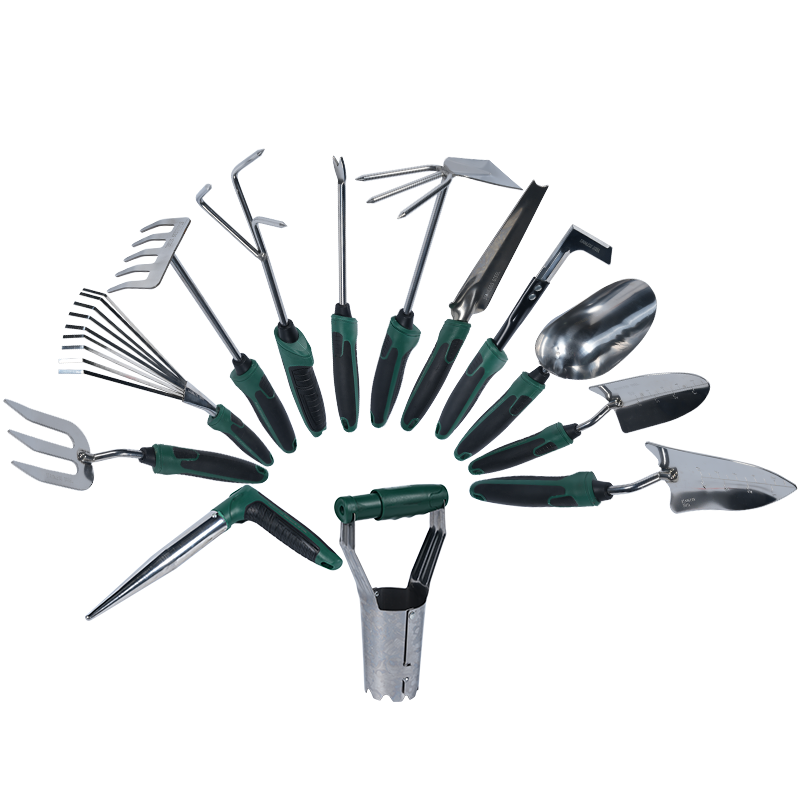
The operational philosophy of a gardening and cultivating tools factory hinges on merging robust materials with intelligent design. Durability is primarily addressed through material science. High-carbon steel or boron steel is often used for blades and tines to maintain sharpness and resist bending, while stainless steel variants are offered for corrosion resistance. The factory's engineering process involves forging or stamping these metals to create a strong grain structure. Functionality is engineered through design. The angle of a hoe's blade, the curvature of a trowel, the width and spacing of a cultivator's tines—all are calculated to optimize soil penetration, leverage, and efficiency. A forward-thinking gardening cultivating tools factory invests in prototyping and testing to refine these geometries, ensuring the tools perform effectively with minimal user fatigue.
The production flow within a gardening and cultivating tools factory is a blend of automation and skilled craftsmanship. The process often begins with blanking or forging metal components, which are then heat-treated to achieve the desired hardness and toughness. These components are ground, polished, and sometimes coated. Simultaneously, handle production runs, typically involving the injection molding of fiberglass-reinforced polypropylene or the shaping and finishing of hardwood. The assembly line is where these components converge. Handles are securely attached to metal heads using methods like epoxy bonding, riveting, or through-tang construction for strength. Final steps include edge sharpening for cutting tools, quality inspection, and cleaning. An efficient gardening and cultivating tools factory streamlines this process to maintain consistent quality while controlling production costs.
A responsible gardening cultivating tools factory prioritizes ergonomics and safety as integral to product design, not as an afterthought. Ergonomics is addressed through handle design, focusing on diameter, length, and contour to promote a neutral wrist position and reduce grip pressure. The weight distribution of the entire tool is balanced to minimize strain on the user's arms and back. Safety considerations are woven into the manufacturing specifications. This includes ensuring smooth, rounded edges on handles to prevent blisters, creating secure connections between parts to prevent detachment during use, and, for long-handled tools, using materials that provide good visibility and non-conductive properties. By focusing on these human factors, a gardening tool factory produces tools that are not only effective but also safer and more comfortable for prolonged use.
To remain competitive, a gardening and cultivating tools factory must navigate diverse market demands. It typically serves several channels: supplying private-label tools to large retail chains, fulfilling custom OEM orders for gardening brands, and sometimes distributing its own branded line. This requires flexible production capabilities. Customization options are a key value proposition, allowing clients to choose handle colors, add branded logos, or specify unique set combinations. The factory must also stay attuned to market trends, such as the growing demand for lightweight tools for senior gardeners or compact sets for urban balconies. Success depends on the factory's ability to combine efficient mass production of standard items with the agility to produce smaller, customized runs, all while maintaining stringent quality standards expected in the gardening sector.
Your email address will not be published. Required fields are marked *

+86-13750999123


South of Gongye Road and west of Gongye Third Road, Lizhai Industrial Zone, Chengdong Street, Dongyang City, Jinhua City, Zhejiang Province, China

Our goal is to provide the market and customers with customized solutions, whether it is a single product or a complete set of equipment.
If you have anything to consult, you can follow us, we will contact you as soon as possible
Subscribe
Copyright © 2022, Dongyang Guorui Industry and Trade Co., Ltd. All Rights Reserved.
Gardening Supplier


